

A 4S 1500mAh 100C battery and a 6S 1500mAh 100C battery might look similar on a product listing. They have the same capacity and discharge rating, but they’re not interchangeable. The voltage is different, and that alone could make one unsuitable for your drone.
Battery labels contain quite a lot of information. Some figures tell you how much energy the pack stores, others indicate how much current it can deliver or how its cells are arranged.
If you’re replacing an old pack or putting together an FPV build, understanding these terms can save you from buying the wrong battery.
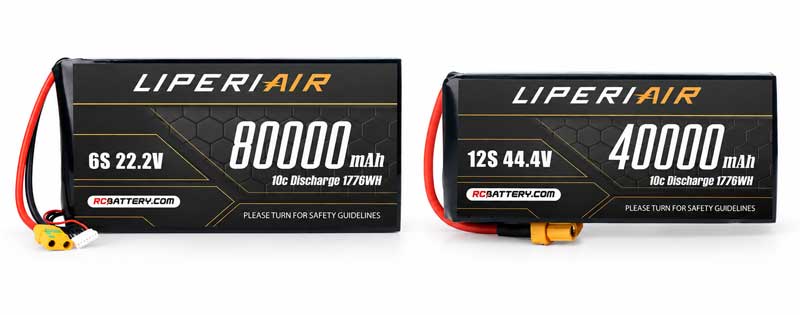
Types of Batteries Used in Drones
Lithium Polymer (LiPo)
Most FPV pilots are familiar with LiPo batteries. They’re used extensively in racing and freestyle drones because they can supply the high currents needed during acceleration and full-throttle climbs.
Conventional multi-cell LiPo packs usually have two connectors: a main power lead and a smaller balance lead.
They need careful handling. Charging with incorrect settings, running the voltage too low or continuing to use a swollen pack can cause serious problems.
Also Read – Drone Battery Life: How Long Do Drone Batteries Last?
Lithium-Ion (Li-ion)
Li-ion batteries are found in many camera drones and long-range FPV builds. They generally store more energy per kilogram than high-discharge LiPo packs, although many individual Li-ion cells cannot deliver the same high currents.
For a drone flying steadily over longer distances, that trade-off may make sense. Racing setups usually need batteries capable of handling much heavier loads.
Lithium Iron Phosphate (LiFePO4)
LiFePO4 batteries have a reputation for good cycle life and thermal stability. They’re less common in flying drones, mainly because their lower energy density means carrying more weight for the same amount of energy.
Reading Drone Battery Specifications
1. Voltage (V)
Start with voltage when comparing replacement batteries.
A conventional LiPo cell has a nominal voltage of 3.7V and reaches approximately 4.2V when fully charged. Connecting cells in series increases the total voltage.
| Battery | Nominal Voltage | Fully Charged |
| 1S | 3.7V | 4.2V |
| 2S | 7.4V | 8.4V |
| 3S | 11.1V | 12.6V |
| 4S | 14.8V | 16.8V |
| 6S | 22.2V | 25.2V |
Suppose your drone runs on 4S and you’re considering moving to 6S. That’s an increase from 14.8V to 22.2V nominally.
Before making that change, you’d need to check the motors, electronic speed controllers (ESCs) and other electronics. Not every setup can handle the higher voltage.
Also Read – 3S Lipo Battery: Voltage, Performance, And Best Uses
2. Capacity (mAh)
Capacity is measured in milliamp-hours (mAh). A 2200mAh battery has a capacity of 2.2 ampere-hours (Ah).
At a constant current of 2.2 amps, that would theoretically provide one hour of operation. A drone rarely draws a constant current, however.
You might be hovering one moment and climbing at full throttle the next. Wind and additional payload also affect consumption.
Larger batteries can extend flight time, although the added weight is worth considering. On a small FPV drone, a heavier pack can change the handling quite noticeably.
3. Cell Configuration (S and P)
The letter S refers to cells connected in series. A 4S battery has four cells connected this way, giving it a nominal voltage of 14.8V.
P stands for parallel. Connecting cells in parallel increases capacity and potential current delivery while keeping voltage unchanged.
A 4S2P pack contains eight cells arranged as two parallel strings of four.
For most standard FPV replacement batteries, the series cell count is the specification you’ll check first.
Also Read – How Custom Lithium Battery Packs Elevate UAV Performance
4. Discharge Rating (C)
C-rating tells you how much current a battery is rated to supply relative to its capacity.
For example, consider a 1500mAh pack with a continuous discharge rating of 50C.
Convert the capacity to ampere-hours:
1500mAh = 1.5Ah
Then multiply:
1.5 × 50 = 75A
That gives a stated continuous discharge capability of 75 amps.
A battery may also list a higher burst rating for brief periods of heavy load.
One complication is that manufacturers don’t always measure C-ratings the same way. A pack labelled 100C isn’t necessarily better than every 80C alternative. Battery quality and performance under load matter too.
5. Charging Rate
Charging current is sometimes expressed using C as well.
A 2000mAh battery charged at 1C uses 2 amps. At 2C, that becomes 4 amps.
Some batteries support faster charging, but others don’t. Check the manufacturer’s stated limit before adjusting the settings on your charger.
Also Read – UAV Battery: Modern Technologies and Future Prospects
Other Battery Terms Worth Knowing
Watt-Hours (Wh)
Watt-hours tell you how much energy a battery stores at its nominal voltage.
The calculation is:
Wh = Nominal Voltage × Capacity (Ah)
An 11.1V, 2200mAh battery stores approximately 24.4Wh.
This is particularly useful when comparing packs with different voltages. Two batteries may both be rated at 2200mAh but contain different amounts of energy.
Battery Management System (BMS)
A Battery Management System monitors conditions such as voltage and temperature. Depending on the design, it may also manage charging and provide protection against excessive discharge or overheating.
You’ll find these systems in many smart drone batteries.
Intelligent Flight Battery
Some drone batteries contain electronics that communicate directly with the aircraft.
Certain DJI batteries, for example, report remaining charge, temperature and warnings through the flight app. Some also reduce their charge automatically when stored for extended periods.
Balance Charging
In a multi-cell LiPo pack, individual cells may not remain at exactly the same voltage.
Balance charging helps bring the cells to the appropriate voltage during charging.
The smaller connector found on many conventional FPV LiPo batteries is the balance lead. A compatible balance charger uses it to monitor individual cells.
Also Read – What RC Battery Connector Should I Use?
Voltage Sag
Watch the voltage reading when you accelerate hard. It may drop noticeably, then recover once you reduce throttle.
That’s voltage sag, and some amount is normal.
If the drop becomes unusually large, the battery might be struggling to deliver the required current. Ageing and increased internal resistance are possible causes.
Internal Resistance
Internal resistance affects how a battery behaves when current is drawn from it.
Higher resistance means more voltage drop and more heat under load. You may notice this most during climbing or sudden acceleration.
Temperature can affect resistance readings, so compare them under similar conditions rather than relying on one measurement.
Need a Battery for Your Drone?
When choosing a replacement, look at the specifications of your existing battery and the requirements of your drone. Voltage and connectors are important, but dimensions, weight, capacity and discharge rating also need checking.
At RC Battery, we can help you compare available batteries if you’re unsure which specifications your setup requires.
Browse our drone battery range or get in touch with us at RC Battery. Share your drone model or existing battery details, and we’ll help you find a suitable option.