

When you’re choosing a battery for your drone, it’s easy to focus on capacity and assume that a bigger number means better performance. But there’s a little more to it than that. The battery you use affects how your drone responds to the throttle, how much weight it carries and, of course, how long you can fly before bringing it back down.
If you’ve spent any time looking at FPV drone batteries, you’ve probably come across 4S and 6S options. Both are popular among RC enthusiasts, and you’ll find pilots who swear by either one. Much of it comes down to the drone they’re flying and what they expect from it.
So, before you spend money on a new battery, let’s look at what actually changes between 4S and 6S and whether those differences matter for your setup.
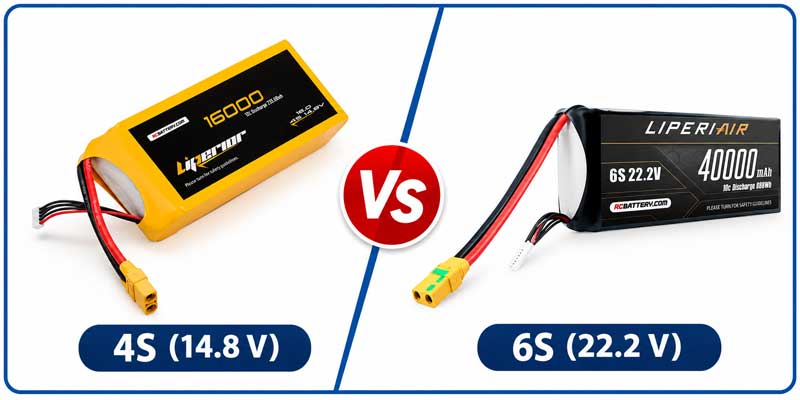
First, What Do 4S and 6S Actually Mean?
The number tells you how many cells are connected in series inside the battery. The letter ‘S’ simply stands for series.
Most FPV drones run on lithium polymer (LiPo) batteries, with each standard cell providing a nominal voltage of 3.7V. Put four cells together in series, and you get a 4S battery rated at 14.8V. With six cells, you get a 6S battery rated at 22.2V.
When fully charged, those voltages increase to 16.8V and 25.2V respectively.
The main thing to understand is that a 6S battery supplies higher voltage. This allows a compatible motor system to deliver the same electrical power using less current, although the benefit you get from that depends on the rest of your drone.
4S vs 6S Drone Battery: What’s Different?
| Feature | 4S Battery | 6S Battery |
| Cells | 4 | 6 |
| Nominal voltage | 14.8V | 22.2V |
| Fully charged voltage | 16.8V | 25.2V |
| Weight | Usually lighter at the same mAh | Usually heavier at the same mAh |
| Price | Generally more affordable | Generally costs more |
| Current draw | Higher at equivalent power | Lower at equivalent power |
| Commonly used for | Recreational and freestyle builds | Racing and performance-focused builds |
These differences are useful to know, but they don’t tell you which battery will perform better on your drone. For that, you need to consider a few other things.
Will a 6S Battery Make Your Drone Faster?
It can, but not simply because it has more cells. Drone motors have a KV rating, which indicates how fast they’re designed to rotate per volt under no load. If you apply more voltage to the same motor, its potential rotational speed increases.
The problem is that motors and electronic speed controllers have operating limits. Putting a 6S battery on a drone built for 4S could push those components beyond what they’re designed to handle. This is why you’ll often find lower-KV motors on 6S drones. They’re selected to work with the higher voltage without running at excessive speeds.
With the right combination of motors, propellers and electronics, a 6S drone can provide strong acceleration and maintain power during aggressive manoeuvres. That may be something you appreciate when pulling out of a steep dive or making quick throttle changes during a race.
For everyday recreational flying, though, a decent 4S setup can already deliver plenty of speed. You may not notice enough difference to justify changing everything.
What About Flight Time?
This is where people sometimes get caught out. A 6S battery has more cells, but that doesn’t automatically mean your drone will stay in the air longer.
What matters is how much energy the battery stores, along with how efficiently your drone uses it. For example, take a 4S 1500mAh battery and a 6S 1000mAh battery. The 4S pack stores approximately 22.2 watt-hours of energy. The 6S pack also stores approximately 22.2 watt-hours.
So despite the difference in voltage and capacity, both hold roughly the same amount of energy. A 6S setup can sometimes be more electrically efficient because it draws less current to produce the same power. But motor efficiency, propeller size, battery weight and your flying habits all affect the final result.
If you’re constantly pushing the throttle, making sharp turns and climbing quickly, you’ll use more energy than you would flying steadily around an open field.
Rather than assuming 6S will give you longer flights, compare the actual battery energy and the performance of similar drone setups.
Does the Extra Battery Weight Matter?
Anyone who’s spent time adjusting an FPV build knows that weight makes a difference, especially on smaller frames. A heavier battery changes how much work the motors need to do. It can also affect the way your drone handles during turns or sudden changes in direction.
At the same mAh capacity, a 6S pack is generally heavier because it contains two additional cells. However, that’s not necessarily a fair comparison when you’re trying to achieve similar flight times. You could choose a lower-capacity 6S battery that stores about the same amount of energy as a larger 4S pack.
Before buying, check the weight and dimensions of the actual batteries you’re considering. Make sure the pack fits your frame and doesn’t add more weight than your setup can comfortably handle.
When Would a 4S Battery Be the Better Choice?
If you already have a drone designed for 4S and it flies the way you want, there’s no pressing reason to move to 6S.
A 4S battery can work well for recreational FPV flying, practising freestyle manoeuvres and plenty of other applications where you don’t need particularly demanding power delivery. Cost is another reason to consider it. Individual 4S batteries are often cheaper than similar 6S options, which becomes relevant when you’re buying four or five packs for a flying session.
For someone relatively new to FPV, a compatible 4S drone can also be a perfectly good starting point. You’ll still have enough performance to learn throttle control and develop your flying skills.
Just remember that battery voltage alone doesn’t determine how manageable a drone feels. Motor selection, weight and flight controller settings matter too.
When Is It Worth Going for 6S?
If you’re planning a new racing or freestyle build, 6S deserves consideration. Its higher voltage allows the electrical system to deliver a given amount of power with less current. In some setups, that can reduce electrical losses and help components operate more efficiently under load.
Pilots who fly aggressively may find this useful, particularly when making repeated throttle changes or demanding sustained power from their motors.
But you need compatible equipment to get those benefits. Your ESC, motors and other electronics must be rated for 6S operation, and you’ll need a charger that supports the pack.
If you’re upgrading an existing 4S drone, check what needs replacing before buying the battery. It may turn into a more expensive upgrade than you first expected.
A Few Things to Check Before Buying
Apart from deciding between 4S and 6S, look at the battery’s capacity, weight, connector and discharge rating.
The C rating tells you the manufacturer’s claimed discharge capability, although ratings aren’t always consistent between brands. A battery with a higher advertised C rating isn’t necessarily better than one from a reputable manufacturer with a lower figure.
Also, make sure you’re buying a pack that fits securely on your drone. There’s little point choosing a high-capacity battery if it’s too large for the frame or adds unnecessary weight.
Whichever type you choose, charge it with a suitable balance charger, follow the manufacturer’s voltage limits and never leave a LiPo battery charging unattended.
So, Which One Should You Use?
For an existing drone, the simplest answer is to follow the manufacturer’s recommended battery voltage. If it’s built for 4S, stick with 4S unless you’re prepared to check and modify the components needed for a different setup.
If you’re starting a new build, consider how you actually plan to fly. A 4S system may be perfectly suitable for recreational use and general freestyle flying. For a performance-focused racing or freestyle drone, the potential efficiency advantages of 6S might make it worth the investment.
Neither is automatically the better battery. What matters is getting the voltage, capacity and weight right for your drone, rather than paying more for specifications you might never make use of. For more information or to place the order for your choice of battery, get in touch with us at RC Battery.