

Whether you are assembling an RC kit on your workbench or upgrading a ready-to-run (RTR) rig, picking your components is half the fun. Most hobbyists spend hours researching motors and Electronic Speed Controllers (ESCs), which resemble the brain of your drive system, regulating throttle and routing power. But one small part often gets overlooked until something goes wrong: the battery connector.
Think of your RC battery connector as the main gateway between your LiPo pack and your ESC. If that plug is undersized or low-quality, it acts like a choke point. Energy gets trapped and wasted as heat, causing a voltage drop right when you punch the throttle out of a turn.
In this guide, we break down today’s standard RC battery connector types so you can match the right plug to your fleet and get maximum punch on every run.
Understanding RC Battery Connectors and Their Uses
An RC battery connector links your battery pack directly to your ESC power leads. Its main job is simple: deliver high electrical current cleanly without creating resistance or coming loose under heavy vibration.
Inside any quality connector, you’ll find three main design features working together:
- Tough Nylon Casing: Withstands high solder temperatures and heavy amp draws without softening or letting internal pins drift out of alignment.
- Gold-Plated Bullet Pins: Solid brass coated in gold ensures maximum conductivity while keeping corrosion off the contact points over time.
- Foolproof Keyed Frames: Shaped walls force positive to positive and negative to negative. You physically can’t plug it in wrong, which saves your speed controller from instant destruction.
Also Read – Why Did My RC Battery Stop Working?
Common Types of RC Battery Connectors
Matching the right plug to your vehicle comes down to knowing what each connector handles best. Here are the main options you’ll run into at the track and flying field:
The XT Series (XT60 vs. XT90)
Amass (officially Changzhou Amass Electronics Co., Ltd.) is the original Chinese electronics manufacturer that designed and created the genuine XT series connectors (XT30, XT60, XT90, etc.). Today it’s easily the most widely used plug system in the hobby.
XT60: This is the go-to plug for 1/10 scale buggies and trucks, 3S/4S sport aircraft, and standard 5-inch FPV drones. Built with 3.5mm gold bullet pins, it handles up to 60 Amps continuously. It’s compact, snaps together firmly, and keeps electrical resistance very low.
XT90 & XT90-S: Step up to 6S power, heavy 1/8 scale bashers, or 90mm EDF jets, and you need the larger XT90. Compared to the smaller XT60, this plug jumps to 4.5mm pins, handles a continuous 90 Amps, and accepts thick 10 AWG battery leads effortlessly. If you hate that harsh “pop” spark when plugging in high-voltage packs, grab the XT90-S. It uses an internal resistor to stop electrical arcing dead in its tracks.
The EC/IC Series (EC3 & EC5)
EC5 Connectors: Built with 5mm bullet pins snapped into a rigid blue plastic shell, EC5 connectors handle up to 120 Amps continuous load. They are a top pick for large-scale Arrma and Losi vehicles running 6S or 8S setups. When comparing Deans vs EC5, the EC5 offers far higher current handling and won’t get sticky or hot under heavy loads. EC3 connectors offer a smaller 60 Amp alternative for mid-sized builds.
Traditional Plugs (Deans / T-Plug)
Deans: Flat spring contacts inside a red housing served RC drivers for decades. Rated around 50 to 60 Amps, Deans plugs work fine on standard 2S brushed models. However, they can be slippery to unplug, easy to warp while soldering, and fall behind modern high-current RC connectors on heavy brushless rigs due to lower contact surface area.
Extreme Power Plugs (AS150 / QS8)
QS8 & AS150: Designed for massive 8S to 12S heavy-lift drones, large RC boats, and 1/5 scale gas-to-electric conversions, these heavy-duty plugs handle 150 to 200+ Amps continuously. They feature anti-spark technology to protect your speed controller terminals from voltage spikes during connection.
| Connector Type | Continuous Rating | Ideal Wire Gauge | Best Application |
| XT60 | 60A | 12 – 14 AWG | 1/10 scale cars, 3S/4S planes, 5″ drones |
| XT90 / XT90-S | 90A | 10 – 12 AWG | 1/8 scale bashers, 6S EDF jets, heavy rigs |
| EC5 / IC5 | 120A | 10 AWG | 1/8 & 1/6 scale Arrma/Losi 6S/8S rigs |
| Deans (T-Plug) | 50A – 60A | 14 AWG | Classic 2S/3S builds & brushed models |
How to Select the Right RC Battery Connector
Evaluating your power system before hitting the field prevents melted plastic and voltage drop. Match your plug using these four criteria:
Current Draw (Amps): Check your motor and ESC peak current draw. Use a 30A plug for mini models, 60A for 1/10 scale, 90A for 1/8 scale, and 120A+ for large rigs.
Wire Size Compatibility: Always match your wire size to the plug’s solder contacts. While 14 AWG wire works cleanly with XT60 plugs, larger XT90s and EC5s require thick 10 AWG wire to handle heavy current without creating a bottleneck.
Standardising Your Fleet: Pick one main connector for your smaller setups and one for your heavy rigs. Standardising your garage simplifies field charging and lets you share batteries between models on busy track days.
Anti-Spark Protection: On 6S setups and above, use anti-spark connectors like the XT90-S or QS8. They absorb that alarming initial “pop” when connecting high-voltage packs, preventing pitting on your contacts and protecting your speed controller.
Also Read – What Do the Numbers Mean? (S, C, mAh)
Why Pre-Soldered LiPerior LiPo Batteries Save Time and Power?
Soldering thick 10 AWG silicon wire requires a high-wattage iron, patience, and steady hands. Poor or cold solder joints create hidden resistance, generating heat right at the connector and wasting pack capacity.
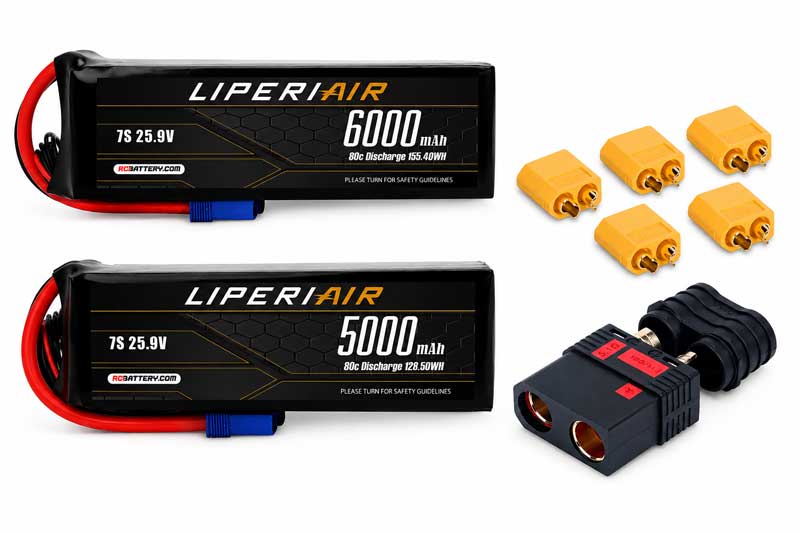
Our Liperior LiPo batteries take the headache out of setup straight out of the box. Every pack in the Liperior lineup comes pre-equipped with factory-installed, industry-standard leads including XT60, XT90, and EC5 plugs. Factory assembly guarantees clean, ultra-low resistance solder joints every single time. You get full power delivery, cooler operating temperatures, and maximum run times right from your first charge.
Concluding Words
In the RC world, top speed and punch get all the hype, but reliability is what keeps you driving. A well-matched, low-resistance connector is the final piece of the puzzle that lets your LiPo deliver its true C-rating straight to the ground. When your power delivery is clean and secure, you get total peace of mind every time you punch the throttle.
Ready to upgrade your power system? Explore our complete lineup of pre-soldered Liperior LiPo batteries and high-grade connectors at RCBattery today.