

When it comes to powering your RC vehicles, moving away from basic starter batteries eventually becomes essential. However, this shift can also be overwhelming considering your choice will dictate the performance of the vehicle. The current RC world is changed and technologically-advanced when compared to earlier times. So, there is very little to be worried about.
According to the Civil Aviation Safety Authority (CASA), licensed remote pilot numbers in Australia have skyrocketed past 40,000 doubling in recent years while recreational flying across local parks and club fields is at an all-time high. Lithium power is the engine behind that growth.
If you want the perfect balance of weight, affordability, and raw power without tearing your vehicle’s drivetrain apart, the 3S LiPo battery is exactly what you need. Often called the “Goldilocks” pack of the hobby, it sits right in the sweet spot. Let’s break down the exact voltage numbers, expected performance, and best applications for your next 3S setup.
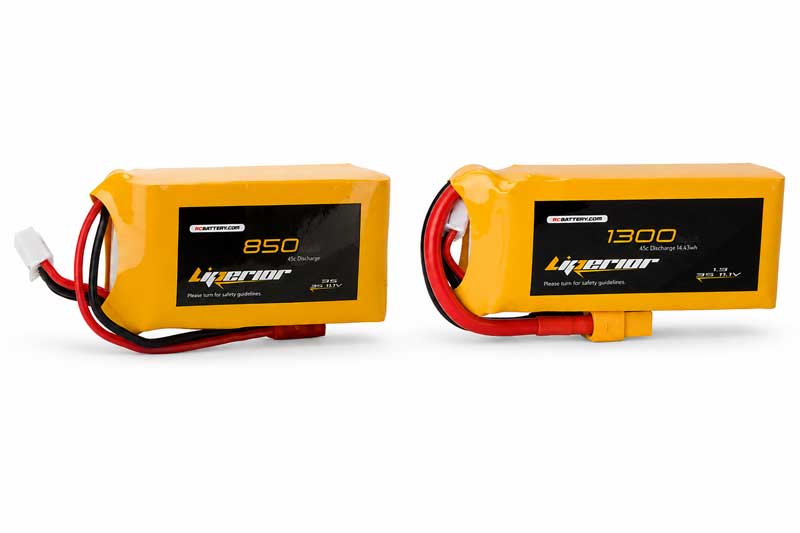
What is a “3S” LiPo Battery?
First, let’s quickly demystify the terminology so you know what is happening under the hood.
“LiPo” stands for Lithium Polymer. These packs completely replaced old-school NiMH (Nickel-Metal Hydride) batteries because they offer a massively higher energy density and a perfectly flat discharge curve. With older batteries, your RC car would slowly get more sluggish as the battery drained. A LiPo delivers maximum punch right up until the battery exhausts.
The “3S” on the label simply means you have 3 individual lithium cells wired in Series. Because every standard cell has a nominal (resting) voltage of 3.7 volts, wiring three together gives you a compact 11.1-volt powerhouse.
However, what is inside the shrink wrap matters. High-quality packs (like our Liperion lineup) use premium internal separators, the microscopic membrane between the positive and negative electrodes. Cheap out on a battery, and that separator can fail under heavy throttle, leading to a destroyed pack or a severe thermal event.
The Core: Voltage, Performance & Best Uses
How does a 3S battery change the way your vehicle performs? The answer to this depends on the motor RPM (Revolutions per Minute).
Electric RC motors are rated by KV (RPM per volt). If you upgrade from a standard 2S (7.4V) battery to a 3S (11.1V) battery, you instantly increase your motor’s maximum RPM by roughly 50%.
However, the “Heat Tax” must be considered. When you push 11.1 volts of heavy current through your system, look out for bottlenecks. If your 3S battery feels like it is losing punch early, check your XT60 or EC5 connectors. If they are getting hot, you are experiencing high resistance and burning your battery’s power as heat.
Here is how to get the most out of 3S Lipo Battery power across the three major areas of the RC hobby:
1. 1/10 Scale RC Cars, Trucks, and Bashers
For surface drivers, hitting 3S is a true rite of passage. If you are running a 1/10 scale builds like an Arrma 3S BLX, a Traxxas Slash, or a Losi stadium truck, moving to 3S entirely transforms the vehicle. You get instant wheelspin on command and top speeds easily pushing 70 to 90+ km/h straight out of the box.
Also, because LiPos are light compared to old NiMH bricks, dropping one into your chassis drastically improves your suspension response, turning handling, and jumping agility.
Pick a Hardcase 3S pack with a 5000mAh capacity for long runtimes at the BMX track or local park. Because surface vehicles pull significant amounts of current from a dead stop, you need a high C-Rating (50C to 100C). If the C-Rating is too low, the battery cannot supply the demand, your voltage will sag heavily under load, and your truck will feel completely sluggish.
2. RC Airplanes, Park Flyers, and Gliders
For fixed-wing pilots at Model Aeronautical Association of Australia (MAAA) club fields, adding a 3S battery is all about optimising your power-to-weight ratio. Airplanes do not need heavy plastic armour, making lightweight Softpacks the undisputed standard.
A 3S LiPo is universally recognised as the best power source for mid-sized park flyers (800mm to 1200mm wingspans). But capacity matching is everything here:
- Pick a 2200mAh pack if you want a light, highly responsive aircraft for 3D aerobatics.
- Move up to a 3300mAh pack if you want to cruise longer.
Remember not to make the beginner mistake of buying a massive 5000mAh battery for a park flyer. You will absolutely turn your agile airplane into a heavy, fast-falling “flying brick.”
3. FPV Drones and Cinematic Quads
In the freestyle FPV world, bigger is not always better. While huge 5-inch racing quads run on aggressive 4S or 6S power, the 3S battery dominates the 2.5-inch to 3.5-inch “Cinewhoop” and micro-drone space.
Why choose less voltage? Because 3S offers incredibly smooth, highly predictable throttle resolution. If you are flying through tight gaps indoors or trying to capture perfectly smooth cinematic video, you want a gentle power band rather than violent acceleration.
Furthermore, pairing a compact 3S softpack (like a 650mAh to 850mAh) with a micro drone helps Australian pilots stay under CASA’s micro-drone thresholds, keeping your setup compliant and noise-free.
Essential 3S LiPo Safety & Voltage Rules
Lithium power is incredible, but it commands serious respect. According to the Australian Competition and Consumer Commission (ACCC), reported safety incidents involving lithium-ion batteries, including swelling, overheating, and fires spiked by 92% in recent tracking. State emergency services reflect this urgency: Fire and Rescue NSW (FRNSW) now responds to an average of 5.7 lithium-battery fires every single week. LiPo safety is not a polite suggestion; it is mandatory.
To keep your batteries safe and long-lasting, adhere to these non-negotiable voltage limits:
- Fully Charged (12.6V): Never charge a standard 3S past this absolute limit. Always use a proper balance charger to ensure each of the three individual cells hits exactly 4.2V.
- Storage Voltage (11.4V): Drain or charge your pack to exactly 11.4V if you are not going to drive or fly for more than two days. Leaving a LiPo sitting fully charged degrades the internal chemistry rapidly and causes the pack to permanently swell or “puff.”
- The Absolute Minimum (9.0V): Stop driving immediately if your battery hits 9.0V (3.0V per cell under load). Discharging below this point causes permanent, irreversible damage.
Always set your Electronic Speed Controller (ESC) to engage its Low-Voltage Cutoff (LVC) early to protect your investment.
Concluding Words
Whether you are launching a foam warbird at an MAAA field, filming tight gaps with a cinematic quad, or tearing up a dirt track at 80 km/h with a 1/10 scale basher, the 3S LiPo is easily the most versatile tool in your pit box.
Why pay a premium for a fancy brand label when you can pay for premium performance? Check your ESC ratings to ensure it can handle 11.1 volts, pick up a high-quality Liperion 3S pack from us at RCBattery.com.