

From precision agriculture and land surveying to emergency response and industrial inspections, unmanned aerial vehicles (UAVs) are being used for increasingly demanding jobs. The aircraft itself tends to get most of the attention, but the battery is doing a lot of the heavy lifting behind the scenes. Flight time, payload capacity, reliability and even operational safety all depend on it.
A UAV battery is the rechargeable power source that keeps a drone in the air and its systems running, including the motors, flight controller, GPS, cameras, communication equipment and onboard sensors. The difficult part is getting enough power without making the aircraft unnecessarily heavy. That balance matters. Even a relatively small improvement in battery efficiency can mean more time in the air, fewer battery changes and less downtime during a working day.
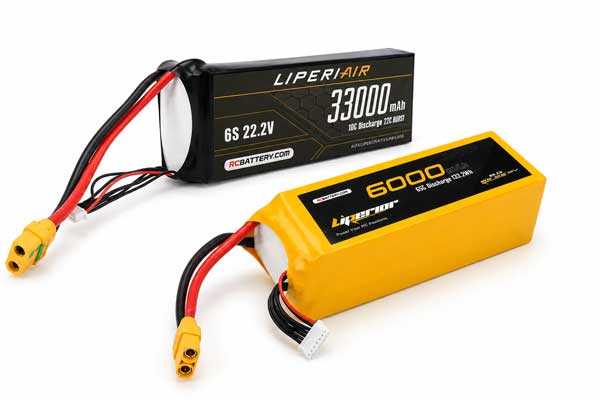
What Actually Affects Battery Performance?
Flight time is usually the first specification people compare, but it doesn’t tell the whole story. A good battery for UAV applications also needs to maintain stable voltage, cope with repeated charging and deliver power consistently throughout the flight.
Commercial operators generally look at a few things together:
- Energy density: Measured in watt-hours per kilogram (Wh/kg), this tells you how much energy a battery stores relative to its weight. Commercial lithium batteries today generally fall somewhere around 200 to 300 Wh/kg.
- Discharge rate (C-rating): This indicates how quickly the battery can safely supply power. Higher C-ratings become particularly useful for drones carrying power-hungry equipment such as LiDAR systems, spraying equipment or cinema cameras.
- Cycle life: Many quality lithium batteries can provide roughly 300 to 500 full charge cycles before noticeable capacity loss. Actual lifespan varies, though. Charging habits, storage conditions and operating temperatures all make a difference.
- Voltage: Higher-voltage packs, such as 6S or 12S configurations, can improve efficiency by reducing the current needed to deliver the required power.
Weather matters too. If you’ve operated a drone on a cold morning, you might notice that the battery doesn’t seem to last quite as long. Lithium cells become less efficient at low temperatures. Heat causes a different problem, as prolonged exposure to high temperatures can speed up battery ageing. Some variation is normal when UAVs are being used outdoors in changing conditions.
Modern Technologies Shaping UAV Batteries
Battery development isn’t just about changing the chemistry inside the cells. A lot of practical progress is also happening in how batteries are monitored, charged and managed.
Intelligent Battery Management Systems
Modern battery packs often come with an integrated Battery Management System (BMS). It monitors things such as cell voltage, temperature, charging history and current draw, while also helping keep individual cells balanced.
For operators, this means more useful information than a basic battery percentage. Many commercial UAVs can estimate remaining flight time based on real-time power consumption. If the wind picks up, for example, the motors have to work harder. Add a heavier payload and the power demand changes again. A smarter system can take these changes into account rather than assuming every flight is the same.
Better Energy Density
Manufacturers are also trying to fit more energy into a battery without simply making the pack heavier.
This is particularly useful for agricultural and inspection drones. If you’re surveying a large site, checking kilometres of infrastructure or spraying crops, another few minutes in the air can genuinely matter. It may mean finishing another section before returning to change the battery.
Across a full working day, even a modest improvement in energy density can reduce the number of battery swaps and keep the aircraft working for longer.
Faster Charging
Charging time is another practical concern. A drone sitting on the ground isn’t inspecting a power line or covering a field.
Modern balancing chargers, better cooling and smarter charging algorithms have helped reduce charging times while protecting battery health. In most commercial operations, however, the answer isn’t simply to charge one battery as quickly as possible. Teams often rotate several packs instead. One battery is flying, another is cooling and another may be charging.
It’s a fairly simple approach, but it can keep operations moving with fewer interruptions.
Smarter Battery Analytics
Some enterprise UAV platforms now go a step further by tracking battery behaviour over time. Charging history, internal resistance and cell balance can all provide clues about how a battery is ageing.
That information is useful because batteries don’t always go from healthy to unusable overnight. Performance usually declines gradually. Spotting those changes early can help operators retire a questionable UAV drone battery before it becomes a problem during a job.
For fleet managers looking after dozens of packs, this kind of battery health data can be particularly valuable.
The Challenges Aren’t Going Away Yet
Battery technology has come a long way, but there are still some stubborn limitations.
Energy density remains one of the biggest. A larger battery can provide more energy, but it also adds weight. Go too far and some of that extra capacity is simply being used to carry the heavier battery around.
Operators also have to deal with performance loss in very cold weather, faster ageing in high temperatures, gradual capacity reduction after repeated charging and the practical requirements of safely storing and transporting lithium batteries.
None of these issues has a perfect fix. Sensible charging habits, correct storage voltage and routine battery inspections do help, though. For commercial fleets, keeping track of battery age and performance is just as important as maintaining the aircraft itself.
Looking Ahead
The next big improvement in UAV battery technology may not come from one dramatic breakthrough. More likely, we’ll see several technologies mature at the same time.
Solid-state batteries are getting plenty of attention because they replace liquid electrolytes with solid materials and this technology could improve safety and potentially provide significantly higher energy density.
Silicon-anode batteries are another promising option. Silicon can store more lithium than the graphite traditionally used in lithium-ion battery anodes, which could help increase capacity without simply making battery packs larger. Lithium-sulfur batteries have even greater theoretical energy potential, although durability and cycle life still need work before they’re suitable for many everyday commercial UAV applications.
Hydrogen fuel cells are worth watching too. They probably won’t replace lithium batteries across the board, but they make sense for certain specialised aircraft where endurance matters more than simplicity. Fuel-cell UAVs have already shown the potential for multi-hour flights in applications such as pipeline inspection, environmental monitoring and long-range operations.
As drones take on more work, expectations around batteries will change as well. Longer flight time will still matter, of course, but operators will also want faster charging, predictable performance, longer service life and better information about battery health.
Power Every Mission with RC Battery
Choosing the right battery for UAV applications isn’t simply about picking the highest capacity on a specification sheet. What matters is whether the battery can deliver the power you need safely and consistently, flight after flight.
At RC Battery, we supply high-quality UAV drone battery solutions for demanding commercial and industrial applications. Whether you’re developing a custom UAV or adding aircraft to an existing fleet, get in touch, we can help you find a dependable battery solution suited to the job.